



 MP Materials Non-equity investment in U.S. rare earth and magnet projects has reached $7.6 billion in 2025 and the first half of 2026, according to a September 27 report in the Wall Street Journal. Citing data from the Center for Strategic and International Studies, the investment skyrocketed to more than four times the total invested in rare earths from 2020 to 2024. Non-equity investments are financial assets or funding arrangements that do not represent ownership or shares in a company. Currently, 180 projects have been initiated at President Trump's direction in an effort to build an independent rare earth supply chain. Currently, China mines, processes and sells most all rare earths.
September's trade summit between the United States and China extended their current trade truce by two months, but failed to resolve issues involving critical minerals. The United States has been expanding efforts to produce, process and research opportunities to beef up its domestic critical mineral supply and loosen China's stronghold on the market.
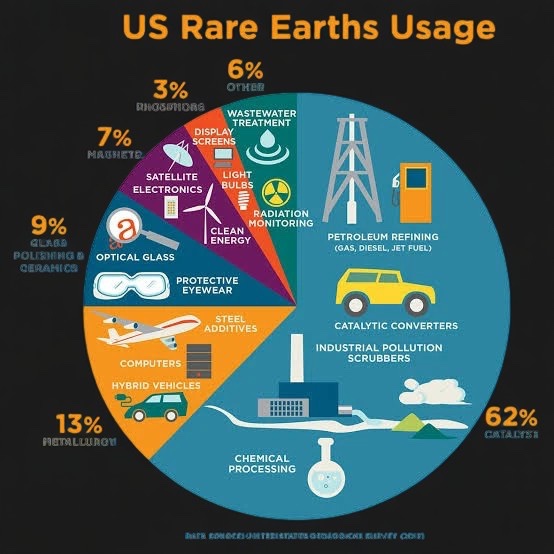 Rare earths are critical to so many things we use. The 17 rare earth minerals are turned into permanent magnets through processing, and used in products such as smart phones, electric vehicles, green projects such as windmills, fighter jets and nuclear submarines. Until 1990, the U.S. was the world's leading producer and exporter of rare earths. Rising environmental concerns and production costs--as well as a pocket sale to China--created an opening for China to dominate the market, at one point accounting for more than 90% of the global market.
The United States eyes building a supply chain independent of China, which could come between six and 18 months, according to Peter Navarro, the White House senior adviser for trade and manufacturing on Bannon's War Rom September 25, 2026. Some experts question that timeline as optimistic, but nevertheless it's possible. Japan, for instance, reduced its dependence on Chinese rare earths from 92% in 2010 to less than 60% today.
Highlights of the U.S. strategy includes building strategic reserves of rare earth minerals, modeling such a reserve on the Strategic Petroleum Reserve, maintaining a 60-day emergency supply of minerals such as gallium and cobalt. The United States is also investing heavily in domestic mining and magnet production. Aside from the $7.6 billion in non-equity investment, the U.S. Department of War spent $400 million to acquire 15% of MP Materials, a leading U.S. rare earth company, with the government agreeing to purchase the entire output of MP Materials' second magnet plant for 10 years. Also, the U.S. is looking into "urban mining," which recovers rare earths from electronic waste. Tax incentives could be offered as incentives for companies that recycle rare earths. To that end, Apple just signed a $500 million agreement with MP Materials to produce rare earth magnets for them, using recycled materials. 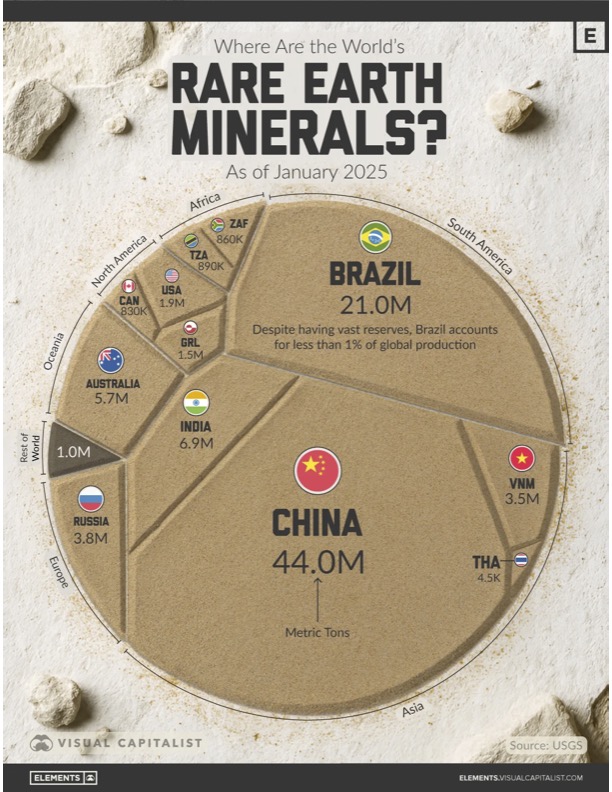
In reporting this information in an October 14, 2026, article, Joyce Huang, of VOA Mandarin, quoted Yuki Kobayashi, senior research fellow of the Japan-based National Security and US-Japan Program at Sasakawa Peace Foundation, as saying cooperation among the U.S., Japan and Europe in consolidating their technologies is key to breaking China's monopoly.
Rare earth minerals are not rare. They can be found virtually anywhere. The challenges, however, are in the actual mining operation and processing the materials. It takes a great deal of earth mining to retreive enough material to make electromagnets. It also requires complicated processing to separate the minerals necessary to make permanent magnets. China has proprietary processes in place that have been superior, but thanks to recent investments in research and development, this advantage may not be as great as it once was.